Bebe

Introducing Xavi Be Like

I met Sean in 2002 but I didn’t get to know him until many years later. Enter our blogs. I read his blog, he read mine and we discovered we had a lot in common when it came to music, TV shows and the like. We’ve both been blogging so long that sometimes it feels like we’ve run out of topics, at least the ones we’re interested in sharing on a public blog. Parenting isn’t one of those topics.

As the child of two long time bloggers, it was only a matter of time before Xavi had his own blog (sorta).

Xavi Be Like is a collection of animated GIFs about toddler life and all the emotions it induces. Xavi’s an awesome kid, but he’s also a toddler who is, well, a toddler. There’s a reason “terrible twos” is a common — phrase not that it applies to our little angel. Nope.

Standard
Bebe

Use your words: Starting over and a review of ‘Late-Talking Children’

Use your words, part I

Before we moved from LA I requested my medical records and did the same for Xavi. It was pretty much all review except for the results of Xavi’s initial assessment with the speech language pathologist. I remember looking through PDF and seeing the raw score, the age equivalent and percentile ranking and feeling like I’d been sucker punched. I wanted to cry.

What I heard from the SLP was “Xavi should get one hour of speech therapy. He also qualifies for early intervention pre-school. Let’s set up the former and you can look into the latter.”

It was something like that. On paper the situation seemed more dire.

Xavi started speech therapy for an hour a week and attended for about six weeks before we moved. The location was close and convenient and Xavi liked playing with new-to-him toys and running around the indoor gym/playground. He was also starting to make some improvements.

In the midst of starting a new job, getting acclimated, and moving I dropped the ball when it came to continuity for Xavi’s speech therapy. I finally called the county early intervention office after his second birthday. I shouldn’t have waited so long. I assumed that with our medical records and Xavi’s initial assessment in April he’d be able to start therapy soon. Nope.

Since we’re in New York, we had to restart the process. I wanted to kick myself. I should’ve called as soon as my new insurance kicked in on my first day at the new job. As expected, it’s taken several weeks to get Xavi in speech therapy once again. In the mean time he’s taken to communicating through lots of pointing, pulling us along, nodding his head, signing and using a few words. I’d love to hear him say “‘Bye, mamá” when I leave for work, but right now a big hug, waving goodbye are enough to give me warm fuzzies.

Below is our timeline:

  • August 3ish: Initial referral, I called the early intervention office
  • August 8: Receive the early intervention parent handbook
  • August 24: Intake session with coordinator
  • September 14: Assessment with speech and occupational therapists; immediately get results which confirm that Xavi has a speech delay and qualifies for services. Devise a plan with the intake coordinator.
  • Currently: Waiting for Xavi’s first appointment with his speech therapist in a week

Aside from waiting, the process has been pretty painless. After reading Late-Talking Children: A Symptom or a Stage? by Stephen Camarata I was worried that we’d have someone who would be pushing a diagnosis that didn’t fit or advocated something that could be harmful.

I started reading Late-Talking Children in the spring. I saw it a bookstore on campus and was intrigued enough to request it from the LA Public Library. I slacked on it and only got through the first couple of chapters. I bought the e-book and finished the second two-thirds a few weeks ago.

Late-Talking Children was exactly what I was looking for. It’s easy to go online and read some parenting magazine’s short post/article about speech delay or another parent’s experience, but I wanted evidenced-based info that was also accessible. Camarata lays out the current research and what is known about late-talking children while also including anecdotes seen through his clinic at Vanderbilt University.

Pointing

While Late-Talking Children is very useful and reassuring, it also left me a bit worried and stressed. The first few chapters made me think that Xavi’s speech delay was a stage he’d grow out of rather than a symptom of something else typically linked to speech delay, particularly autism. This was probably why I got lazy and stopped reading initially. Plus, by that time Xavi was already in speech therapy and we were happy with the services he was receiving.

As I started reading more I got worried. Camarata writes about several cases where parents and their children didn’t receive the treatment they needed or clinicians/educators insisted on a certain diagnosis. He acknowledges that these instances are not the norm, but it’s still enough to make you think you’re going to need to go to battle every time you speak to a pediatrician, teacher, speech therapist or other professional who works with early intervention programs. Plus, I couldn’t help wondering about the socioeconomic aspect. I imagine it can be intimidating to argue about an IEP with teachers or clinicians if you’re not fluent in English or they talk down to you because you don’t have multiple degrees from fancy colleges or universities, not that this means everything will be easy as seen through Camarata’s personal experience. He and his wife, an experienced speech pathologist, faced challenges trying to get their late-talking son in a mainstream classroom. While they were both experts in this area, they still faced push back from the teachers and clinicians who were supposed to have his son’s best interest at heart. Yikes.

Thus far, I haven’t felt like I’m doing battle. It’s been the opposite as the only challenge has been waiting a pretty normal amount of time from referral to beginning speech therapy. The handbook we received from NY early intervention office clearly outlines parents’ rights such asking for a second evaluation or declining services. For instance, if the occupational therapist found that Xavi had issues with fine or gross motor skills and recommended occupational therapy, I could have declined this without affecting his right to have speech therapy.

Interesting thing to note: Camarata never mentions bilingualism as a possible cause for late-talking in his section on characteristics of late-talking children.

Overall, I recommend reading Late-Talking Children if you want to be better prepared to advocate for your child if he/she needs early intervention services.

Late summer

Xavi’s review: I like this book because there’s a train on the cover. [Seriously, I had to hide the hardcover book when I had it because Xavi would take it away from me. He loves his trains and instantly likes a book more if it includes a picture of a train.]

Standard
Bebe, Familia

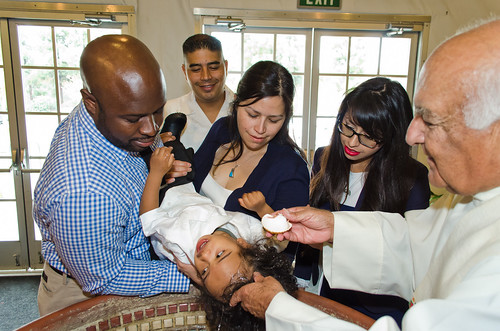
Xavi gets baptized

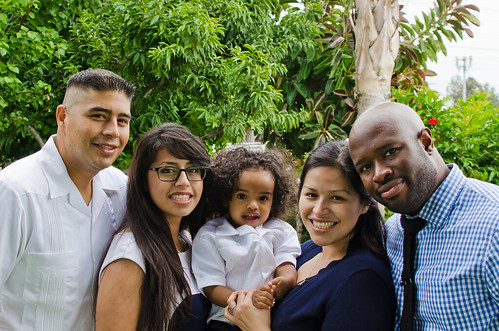
Godparents and parents

Sean and I have a lot to do in before we leave LA. One of the things that seemed most urgent was getting Xavi baptized.

It was never a question that he would be baptized. Sean and I promised it a few times in preparation for a Catholic marriage. It’s customary to baptize children as infants. I was baptized before I was a month old. Mexicans throw big parties to celebrate this with food and “bolo.” The godparents throw out coins and there’s a mad scramble to pick them up. It’s like the piñata candy melee but more people join in because who doesn’t need some quarters to do laundry or to add to the piggy bank?

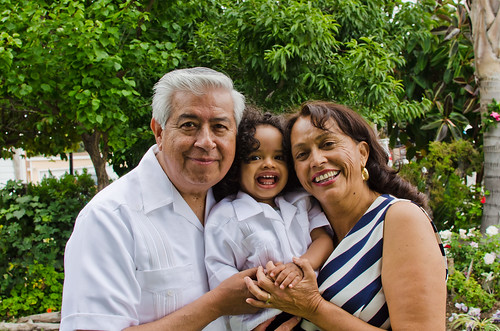
Proud grandparents

My mom kept bugging me about it and I shrugged off her exhortations because we hadn’t decided on godparents. It’s not an easy decision. Being a godparent means a lot of things, but I didn’t want it just to be an honorific. I wanted Xavi’s padrino and madrina to accept the responsibility to be co-guides of Xavi’s faith journey.

So, while I was helping a group of 17 teens prepare to be fully initiated Catholics – that’s when you’ve been baptized, and done the sacraments of Reconciliation, First Holy Communion and Confirmation – I was delaying the first step of that process for my own child. Oh, irony.

When leaving LA became a reality in early May we needed to make a decision.

Baptism style

Sean and I picked Danny and Lori to be Xavi’s padrinos. Xavi asked them on Mother’s Day with little notes saying, “will you be my padrino/madrina?” Of course they said yes, and almost cried. They’re both ecstatic just being uncle and aunt to their first nephew, now they get to do a little more.

We rushed through the process of selecting a church, picking a date and taking the preparation class. We were able to get in last minute at St. John Vianney in their parent and godparent preparation class. Sean and I go to mass at SJV about once a month and it still feels like home when I see lots of familiar faces. That happened during the class too. Two of the four couples leading small groups were friends’ parents.

Last Wednesday we took the course and I was reminded why I chose Danny and Lori and what I want Xavi to learn from them.

Trío Mosqueda Campbell

I was pretty shy as a kid but Danny was the opposite. He took on the trailblazer big brother role with gusto and I was grateful for it. I joined all the activities he did up through high school. I even chose trombone because Danny played trombone. Having him there made everything easier and less daunting, even if I was mainly known as Danny’s Little Sister. My big brother’s willingness to get involved extended to church activities like altar serving, choir and youth group (yup, did all three). He also made all the church ladies love him. So, from Padrino Danny I want Xavi to be willing to get involved and share his talents. I want him to get that first born sense of responsibility of being an example to your younger sibling(s) or cousins.

Madrina Lori and Padrino Danny

Xavi has three uncles, but only one tía, Lori. I know she relishes that role. As my only sister, we have a very close relationship and complement each other. Lori has a beautiful singing voice and we harmonize quite well together. We join dad and Danny in our small family choir at funerals for friends and family. Aside from offering up her voice, she also reminds me that prayer can take many forms. On her trail runs she prays for those who cannot run and reflects on the beauty in our surrounding environment. I want Xavi to learn from his Madrina Lori that it’s important to share your voice and other talents. Also, prayer can take many forms.

Xavi gets baptized

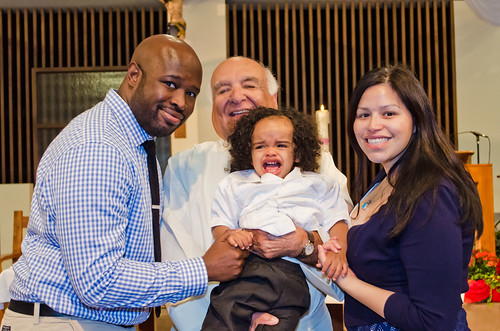
As for the actual baptism, Xavi didn’t behave as well as he usually does in church. He was squirmy, “talked” a lot (he says ma-ma now!), sat on the floor and cried at different parts. We’ve heard kids scream “nooooo!” in the middle of being baptized, so at least it wasn’t that bad considering he was teething and we cut his nap short.

Not up for picture time

He was definitely the loudest (and oldest) of the six babies being baptized. He also had the most hair and was the only one who didn’t do the traditional baptismal gown. Do they even make those in 2T?

Proud grandparents

Adrian and Alexis

We kept the celebration small since the day before my parents had already hosted a party. My cousin Angelina threw a party with a King Taco truck and mariachi to celebrate her daughter Star’s confirmation and son David’s First Holy Communion.

Kisses for Xavi

We’re thankful Xavi so many strong examples, hopefully that shines through in Skype and FaceTime.

Standard
Bebe

Use your words: Dealing with speech delay

Earlier this month I was sitting down to lunch with some people I had just met. One asked, “So, what do you do for fun?”

I waited to answer. Not only because I was in the middle of chewing, because a number of the things I do for fun, I no longer, well, do. I ran. I went to movies. I went to Dodger games and lots of concerts at awesome venues. I spend time with family.

Playground

I don’t do most of that stuff anymore because I’m engrossed in figuring out my new role, being a mom to Xavi. And yes, that is often fun.

So, I said, “Well I like spending time with my family. And I have a toddler so a lot of my ‘fun’ is playing with him.”

I was immediately asked follow-up questions.

“How old is he?”

“Twenty months.”

“Oh, that’s such a great age. The next couple of years are going to be so much fun,” said the second guy who I later learned is the father of toddler twins.

Sprinkler fun

“Is he a talker?” asked the first guy.

I paused (chewed) again.

“No. He actually doesn’t have many (well, any) words. We’re going to get him evaluated soon…”

Both told me about family members who had hearing issues or did not speak until five years of age. They assured me that everything worked itself out.

Easter Sunday

Xavi will be 21 months in a few days and his language is not where the it’s supposed to be. He doesn’t have the 5-10 words [or whatever it is, too lazy to look up something that’s going to turn up BabyCenter or WebMD — I’ve already seen those sites] considered normal for a toddler his age.

He babbles a ton. He says “dada”, but not to refer to Sean. He says “dis” (this) and points. He used to say “trash” as we would go to the diaper pail to throw out his dirty diapers. My mom and his former babysitter insisted that the “tinti” he said was actually Cindy. And he imitated me as I said his babysitter’s name. He doesn’t say mama.

When Xavi was 18 months old, we brought up our concerns with our pediatrician, Dr. H. First he asked where the concerns were coming from. Are you comparing him with other kids? Are your families or friends bringing this up? Nope. It was all me and Sean. Then he asked some basic questions and concluded that given that Xavi has hit other development milestones and has been very healthy thus far, he saw no reason to be concerned. He said Xavi was “certainly not advanced with speech development, not that there is anything wrong with that.” He’d be concerned if Xavi was 30 months old and used so few words, but at 18 months he didn’t see cause for alarm. Dr. H assuaged our worries more by offering to refer us for an evaluation at the speech and language therapy department if we chose. “Just email me and I’ll send it.”

That made me feel better.

Wedding swag

Sean and I decided to take a wait and see approach. In the mean time we read about other parents’ experiences with speech delay and speech therapy.

Six weeks passed and nothing changed. Xavi stopped repeating me when I said we were taking his diaper to the trash and going to his babysitter’s house. I started to feel like I needed to do something. What if he really needs help? I’d read about the referral process and knew that it could be a couple months before he ever saw a speech therapist.

The evening after my lunch meeting I told Sean that I asked Dr. H for a referral. Dr. H complied and within a few hours the referral was in our HMO’s system. Sean made an appointment the next day. Within two weeks we were seeing the speech language pathologist for an evaluation. The sessions with the SLP lasted about 30 minutes and she asked a series of questions regarding Xavi’s expressive and receptive language. She confirmed that he is speech delayed and qualifies for speech therapy and another early intervention preschool/daycare program.

Grandpa made Xavi a desk

The evaluation was affirming. It’s hard to think that there might be something “wrong” with Xavi or that I could have done more to help him develop speech. I know that speech delay is very normal and that there is nothing actually wrong. I know that we are lucky to have access to resources to give Xavi a little nudge.

I felt so much better after leaving our session with the SLP. Hearing that he did qualify for services was nice, but it also made me realize a few things. Xavi does know a lot of words, even if he isn’t saying “mama, agua”. During the evaluation, the SLP pointed to pictures in a book and asked Xavi, “Where is the ball? Where is the bird?” I figured Xavi knew “ball” since we frequently throw various balls around the apartment, but was surprised when he correctly identified the bird. She also gave him a two-step instruction (e.g., get the train, take it to mommy) that he partially followed. When she saw our faces look a little bummed that he stopped partly through the direction, she said, “It’s okay. This is more advanced than his age.”

Second, simply watching the SLP’s interaction with Xavi made me realize there was more I could be doing to help him learn words. Sean and I both read to him daily and point to objects when we’re at home or out on a walk. I don’t put those together and realize I should be pointing more to the objects in his books. The SLP also advised us to draw attention to our mouths as we name objects. I’m sure I’ll learn more once Xavi has first session with the speech therapist.

First cornrows

For now, I know that his expressions and actions say more than I can understand. While Xavi learns words, I need to learn to better pick up on his non-verbal cues.

Standard
Bebe

Mornings with Xavi

In late January Lupe, Xavi’s nanny informed us that she would be taking a trip to Colorado where her daughters live. She also said she might not return. This wasn’t the first time Lupe took a well-earned vacation. However when she went to Texas in October to visit family she didn’t plan to move. We worked out her last day and started calling around for some new childcare options. Lupe even referred a few people but we settled on an in-home day care in our neighborhood we could walk to. Proximity was key since we have one car which Sean drives to work 20 miles away and I handle the mornings.

The change worried me. I knew Xavi would have a tough time, that drop-offs would involve tears and clinging. But I knew he would adjust. More selfishly, I knew my adjustment would be more difficult.

With Lupe our mornings were much different. Basically, I was spoiled and oftentimes she’d take over as soon as he woke up. All I had to do was get myself dressed. Lupe handled Xavi’s diaper change and sat him down for breakfast. Typically I’d leave and he’d be content munching on some banana and eggs. There were never any tears when I left.

New morning routine means more Xavi smiles

Sean would get home first and begin dinner. Sometimes Sean would even put Xavi to sleep at an early bedtime or he’d fall asleep as soon I got home. It bummed me out to spend such little time with him during the weekdays.

Now at about 6 weeks in to our new arrangement and knowing that Lupe’s move is permanent we’ve adjusted to the changes. And I like it.

Sure, there were tears on those first few drop-offs and pick-ups — I think Xavi just gets attached to his caretakers. But he’s adjusted to the new routine and there’s no more crying.

And yes, the colds — yes, he’s has two so for — Xavi managed to avoid all winter finally got him. And yes, I’ve had to adjust my work hours to come in a little later and leave a little later. And yes we do miss Lupe.

Giggle fit

But now we have time for playing in the morning.

And that’s awesome.

Standard