Corriendo

Twenty-two through the Westside

Yesterday morning, I woke up, made some coffee, ate peanut butter toast with bananas and then proceeded to run 22 miles (longest training run I’ve ever done).

I missed some stuff there. I procrastinated for 90 minutes by watching Saturday Night Live, catching up on Words With Friends games, and hoping a sunny morning would suddenly become overcast. It didn’t.

Beachside running

I eventually got going a little after 9 and ran up in to Beverly Hills and through the final 8 miles of the LA Marathon course. About two hours later, I was at the beach admiring the views of the Pacific Ocean from Palisades Park.

I’ve run this route half a dozen times in previous marathon training cycles. I like it because it helps familiarized myself with the end of the marathon route, but it’s also challenging. The final 4-5 miles are on San Vicente Blvd through Brentwood and in to Santa Monica. It’s one of the best places to run in LA thanks to the tree-lined streets, a soft surface on the grassy median, water fountains, few stoplights and traffic, and plenty of other runner, walkers and cyclists. It’s also on a nice decline, which is less fun if you’re doing an out-and-back.

Quick break @ Palisades Park in Santa Monica

At Palisades Park, I stopped for a few minutes to refill my water bottles and take some photos. I’ve never taken pictures during a training run (or race) before. I hate carrying unnecessary items while I run. For a 22 mile run, I don’t feel comfortable without a phone. Now that I have a decent camera on my phone, that meant some pictures.

The second half of my run took me back the same way I came. On tired legs all the hills felt tougher and I felt like walking some. I stopped a couple of times, but started running after a few steps. I need to practice going up hill on tired legs considering there are some hills at miles 18 and 20 on the course. I finished off the last mile with some strides (about a couple blocks each). That helped me have my final mile be the fastest at 9 minutes.

I finished in 3:33:21, which puts me at a decent pace for my long runs.

As far as recovery, I felt pretty good and today I hardly felt sore. In the past when I’ve run 20+ miles, it hurt to sit the following day and my legs felt stiff. I didn’t have any of that. I’m going to credit the last ~9 weeks of strength training for the good recovery.

Post long run tan

One thing the run did leave me with was with a goofy tan line. At least it’s cool enough to wear tights with skirts these days.

***

One other thing about this week in marathon training. My Wednesday tempo run called for a 1.5 mile warm-up, 2 miles at 8 minute pace, and a 1.5 mile cool down. I was bit intimidated by this as 8:0X miles are quite difficult for me.

I did the workout on the track at UCLA. The tempo miles definitely felt challenging, but not insanely difficult. I think I nailed it.

Standard
Cultura, Política

Out of the classroom, but still on my bookshelf

Banned books (sort of)

I got the idea to start the This Day in Chicana/o History series some time in late 2009 or early 2010. I was inspired partly by other bloggers documenting Los Angeles history and by The Writer’s Almanac, one the many podcasts I listen to daily. After searching online and in old Chicana/o Studies textbooks for birthdays of famous Chicanas/os and dates of important events, I started the series. I wasn’t consistent with it back then and abandoned the project after a few months. (Definitely one of my weaknesses as a blogger and person in general.) I hope the current revival lasts especially in light of the struggle for a relevant education in Tucson.

When I started this project in early 2010, I had no clue a law banning ethnic studies was in pipeline in the Arizona legislature. HB 2281 particularly targeted the Mexican American studies program in Tucson Unified, a predominantly Latino school district. In May of 2010, Governor Jan Brewer — yeah, the one with her finger all up in President Obama’s face — signed the law. Tucson educators resisted the law and held on to Mexican American Studies until January when the Tucson Unified School District board voted to suspend the program or lose state funding. Over 80% of the books used in MA Studies courses were forbidden from being taught in the classroom. I’ve read many of these books, some are amongst my favorites. I read most in Chicana/o Studies courses in college.

Some books that were removed from Tucson classrooms

Before I ever took a Chicana/o Studies course, I became more invested in school when the subject was my history or the authors of the assigned books had Latino surnames. This is saying a lot considering I was quite the nerd, especially in history and English. In sixth grade, I wrote a report on Edward James Olmos for my project on a famous American. It was the first time I ever read about the Sleepy Lagoon trial, zoot suits and Chicano theater.

In the summer before 10th grade, I read Rudolfo Anaya’s Bless Me, Ultima as an assignment for honors English. While I’d never been to New Mexico, stories of curanderas and witches who turn in to owls and have healing powers were vaguely familiar. I’d heard similar tales from my cousins who spent some of their youth in Mexico. In discussing the book in class, I hated my teacher’s take on it and how she pronounced Ultima (ul-TEE-mah).

Both Luis Valdez’s Zoot Suit and Other Plays (Olmos starred in the stage and film version of Zoot Suit) and Bless Me, Ultima will no longer be taught in Arizona schools. They’re just two books on a long list.

Chicano and American Indian lit

I haven’t read many of the banned books in years, but I’m committed to re-reading them thanks to Feminist Texican’s Read & Resist project. While this won’t introduce books directly to Tucson youth, it may shed some light on how ridiculous it is to remove these books from the classroom and get us talking about the important of a relevant education.

As for the This Day project, you may have noticed that all the postings this year are about famous men. I have many women on the list, but could use more. If you have any suggestions of people of events for the project, let me know in the comments or email me.

Standard
Comida, Familia

V-day dinner by Chef Danny

Lori's balloons were the centerpiece

My brother, Danny, invited Sean and I to a Valentine’s dinner over the weekend. I know V-Day isn’t a family oriented holiday, but Danny’s a trained chef and it’s kinda rare that I get to eat anything he makes. Whenever I see him he’s usually exhausted from work. Sean liked the idea of a home-cooked gourmet meal rather than going out to a restaurant.

Traffic from LA to Hacienda Heights was horrible, but it was worth it. Danny made a delicious dinner with a little help from me, Lori and Costco. I like helping him out, it actually makes me feel like I know something about cooking.

We sat down to dinner a little late, but it was fine with me and accommodated my parents’ schedule.

Green salad

Green salad

Shrimp in a cayenne butter sauce with garlic asparagus

Shrimp in a delicious cayenne sauce

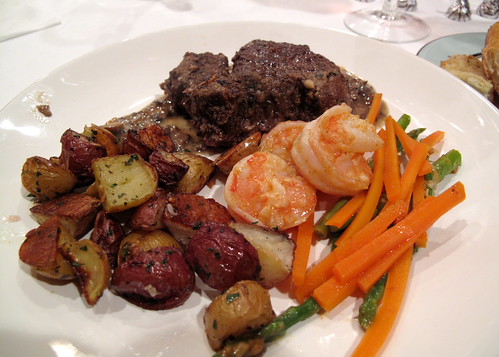
Filet mignon with a mushroom sauce, shrimp, roasted potatoes, asparagus and carrots (not pictured: garlic bread from the grocery store)

The main course

Apple pie a la mode (from Costco)

Apple pie & vanilla bean ice cream

I was so stuffed.

My favorites were definitely the cayenne shrimp and the mushroom sauce.

V.R. breaks out the sad puppy dog eyes for a chance at some steak

As or VR, he was really working the puppy dog eyes angle to get some steak.

Standard
Familia

Love and other L words

My grandparents are adorable too

My celebration of love typically comes two weeks before February 14 when my extended family gathers to celebrate Papá Chepe and Mamá Toni’s wedding anniversary.

Ureño Saldivar family, 1968

I believe the Ureño Saldivar family has been throwing anniversary parties since 1968, the 25th anniversary.

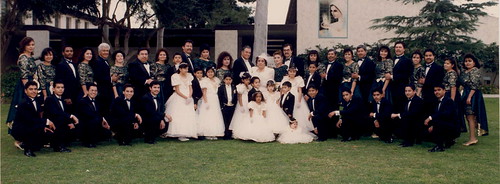
Ureño Saldivar grandkids, 1983

I don’t remember the party for 40th anniversary, but I was there in a frilly dress.

50th Wedding Anniversary

I do recall the huge party for 50 and the whole family dressed in forest green and gold. I thought it was so cool that my grandparents had reached such a milestone. A year later, my fathers’ parents, Grandpa Bartolo and Grandma Juana, also celebrated their 50th anniversary.

Most of the celebrations are low-key, save for the numbers divisible by 5. Since the 60th anniversary, we’ve gathered annually on the last weekend of January to share a meal and celebrate the beginning of our little* extended family.

Celebrating the grandparents' 69th wedding anniversary

This January, the 69th anniversary, we celebrated love, luck, longevity and loyalty. After all, love isn’t all you need to stay together for nearly seven decades.

*The Saldivar family had a big reunion in 2003 (or 04?). After studying a huge family tree, I realized that Mamá Toni’s branch of the family is much smaller than most of her brothers’ and sisters’ families. I have a few cousins compared to my mom.

Standard
Historia, Los Angeles

This day in Chicano history: Edward R. Roybal (1916)

February 10, 1916: Edward “Ed” R. Roybal was born in Albuquerque, New Mexico

While Roybal was born in New Mexico, he’s closely linked with mid-century Los Angeles history. His family moved to Boyle Heights in the early 1920s, he graduated from Roosevelt High School (like my mom), attended UCLA (go Bruins!) before going on to a long career in public health, community organizing and politics.

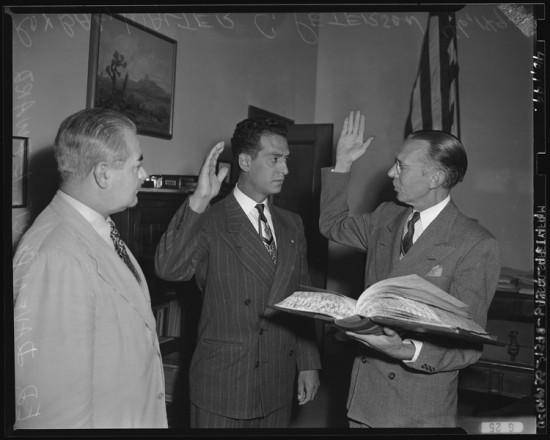
In 1949, Roybal was elected to the LA city council. There were some road bumps.

In 1993, Roybal told The Times that at his first City Council meeting [in 1949], he was introduced as “our new Mexican councilman who also speaks Mexican.”

“My mission was immediately obvious,” he said later. “I’m not Mexican. I am a Mexican American. And I don’t speak a word of Mexican. I speak Spanish.”

It became his role, he said, to educate his fellow public officials about Latinos and to pay special attention to what he felt were the long-neglected needs of his largely Latino constituencies. [Source: LA Times obituary, 2005]

In 1962, Roybal moved on from local politics to the national DC and became the first Latino from California to serve in Congress since 1879 (source). He was later appointed to the Appropriations Committee and became an “influential advocate for federal funding for health, education, community health programs and bilingual education.” [Source]

Some highlights from his long career provided by the USC Edward R. Roybal Institute on Aging:

  • Author of the 1968 legislation that established the National Bilingual Education Act to assist schools in meeting the educational needs of children who come from non-English-speaking homes.
  • Played an important role in the passage of legislation outlawing age discrimination and fought for benefits and opportunities for those with disabilities.
  • Responsible for funding America’s first AIDS research and treatment programs
  • Championed the first federal funding for Alzheimer’s Disease and was instrumental in renewing legislation to provide medical service to people with the disease
  • Led the campaign to restore funding for programs for the elderly, including a senior citizens’ public housing program and a community-based alternative to nursing homes
  • Successfully maintained the Meals on Wheels program and protected veterans’ preferences in hiring in 1982
  • Consumer rights defender
  • Co-founder of the House Select Committee on Aging, serving as chairman from 1983-1993
  • One of the first legislators to introduce legislation to establish a national health plan for the United States
  • Founder of the Congressional Hispanic Caucus, which he served as both president and treasurer
  • Founder of the National Association of Latino Elected and Appointed Officials (NALEO)

I noted Congressman Roybal’s passing in 2005 and wrote: “It’s amazing to think that many of the issues he worked on as a Councilman in the 1950s and then as a Congressman, such as police brutality and immigration, are still problematic. For anyone from LA who has studied the history of Chicana/o politicians, there is no way to avoid the impact of Ed Roybal on the growing political power of Latinos.”

Photo of Edward Roybal being sworn in to the LA City Council in 1949 from the Los Angeles Times photographic archive, UCLA Library. Copyright Regents of the University of California, UCLA Library.

Standard