Historia

This day in Chicano history: Rubén Salazar (1928)

Ruben Salazar, circa 1970

March 3, 1928: Rubén Salazar born in Ciudad Juárez, Chihuahua, México

Four years ago, the US Postal Service issued a stamp commemorating Rubén Salazar and a few other notable journalists. I went to the Lincoln Heights post office with my cousin Nancy and picked up a few of my own. I’ve never used them. Later that day, I wrote a post, A Chicana outlook on Rubén Salazar — heavily cribbed from an older post — where I liberally quoted a friend and fellow blogger, César (El Más Chingón). César wrote about feeling cheated that in his 20s, he was barely learning about Salazar’s life and death. I could definitely relate.

Salazar’s violent death at the hands of LA County Sheriff’s deputy Thomas Wilson is often remembered. Over forty years after the Chicano Moratorium, there’s still investigation and speculation over what happened that day. Whether it was an accident or assassination is still up for debate depending on who you ask, but what remains clear is that an important Chicano voice was lost on August 29, 1970. [See: Finally, transparency in the Ruben Salazar case and the Ruben Salazar files]

While Salazar’s death is important, we should also remember his life’s work. Rosalío Muñoz points this out in a recent piece commemorating Salazar’s 84th birthday at KCET Departures:

Pioneering Latino journalist Ruben Salazar died at the hands of Los Angeles Sheriff’s as they broke up the August 29, 1970 Chicano Moratorium against the Vietnam War. Today, his story is an inspiration to the Latino community, and to all those seeking social justice.

That’s why we should celebrate his birthday, and not just remember his death. [Source]

Ruben Salazar interviews civilians in Vietnam

If you don’t want to go read those posts about Salazar, here’s what you should know about him:
Salazar was born in Ciudad Juárez and later emigrated with his family to El Paso Texas. He earned his BA at the University of Texas El Paso thanks to the GI Bill. He became an investigative journalist at a time when few Chicanos held such jobs. From Texas, he came to California and worked for a couple of newspapers including the Los Angeles Times. He wrote articles giving a voice to Chicanos working to change the status quo. Although his career was cut short, his legacy and words live on amongst us “Mexican-Americans with a non-Anglo image of [ourselves]” (see: Who is a Chicano? And what is it the Chicanos want?, February 6, 1970).

Photo credits: UCLA Library’s Digital Collection, Changing Times: Los Angeles in Photographs, 1920-1990. Los Angeles Times photographic archive, UCLA Library. Copyright Regents of the University of California, UCLA Library.

Standard
Historia

This Day in Chicana herstory: Josefina Fierro de Bright passed away (1998)

March 2, 1998: Josefina Fierro de Bright, born in Mexicali (1920), passed away

Quick. Name a Chicana labor organizer.

No, not Dolores Huerta or María Elena Durazo.

Stuck?

How about Josefina Fierro de Bright?

Unfamiliar? Check out this short biography from Chicanas.com (a great website on some badass mujeres):

Josefina Fierro de Bright was born in Mexico in 1920. She grew up in farm labor camps as the daughter of a bordera who served meals to migrant workers in Madera, California. Josefina gave up her studies at UCLA to become an organizer, and her style was described by veteran longshoremen’s leader Bert Corona as gutsy, flamboyant, and tough. As executive secretary of El Congreso (the first national Latino civil rights org) from 1939 to the mid-1940s, she organized protests against racism in the LA Schools, against the exclusion of Mexican-American youths from public swimming pools, and against police brutality. In 1942, she was a key figure in organizing the Sleepy Lagoon Defense Committee, to support the seventeen Chicano youths held without bail on little evidence for the alleged killing of one youth. With Luisa Moreno, she helped to coordinate El Congreso’s support for Spanish-speaking workers in the furniture, shoe manufacturing, electrical, garment, and longshoremen’s unions.

— from Dolores Hayden, “Reinterpreting Latina History at the Embassy Auditorium” in The Power of Place: Urban Landscapes as Public History.

In an article on El Congreso del Pueblo de Habla Española (the Congress of Spanish-Speaking Peoples) Carlos Larralde expands on Fierro de Bright’s involvement with El Congreso:

Another important activist, Josefina Fierro de Bright, managed the day-to-day operations of the Southern California chapters of El Congreso while, at the same time, attracting writers and movie stars to the cause. Her husband, John Bright, was a Hollywood screenwriter and a founding member of the Screen Writers Guild. Together, they entertained luminaries such as John Steinbeck, Lillian Hellmann, Theodore Dreiser, Orson Welles, Robert Lowell and others. In addition, Fierro de Bright played a major role in curtailing the so-called Zoot Suit Riots, pleading with the Los Angeles Times to curtail sensational journalism. She corresponded with Eleanor Roosevelt and helped the administration smooth diplomatic relations with Mexico.
– Larralde, C. M. (2004). El Congreso in San Diego: An endeavor for civil rights. The Journal of San Diego History, 50(1 & 2). [PDF]

If you want to read more about Chicano civil rights organizing pre 1950, check out Becoming Mexican American: Ethnicity, Culture, and Identity in Chicano Los Angeles, 1900-1945 by George J. Sánchez. Chapter 11, “Forging a New Politics of Opposition” is specifically about el Congreso.

Standard
Corriendo

Third time around

3rd time around

I’m 18 days away from the LA Marathon and I’m feeling pretty good. This is a big difference from last fall’s taper for Long Beach. Other differences between previous marathon training cycles last summer/fall and winter (Los Angeles):

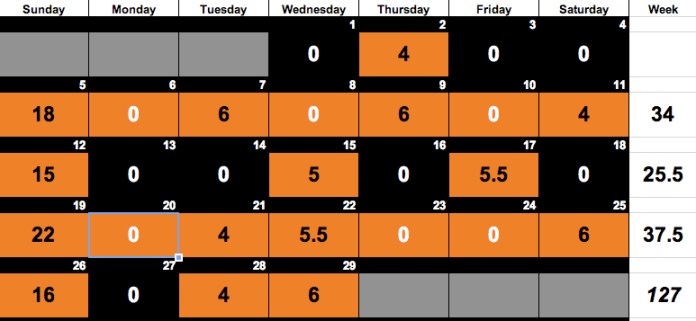
1. I’m on a truncated training schedule. I didn’t begin training until after the Carlsbad Half on January 22nd. I worried that 8 weeks wouldn’t be enough. I’d barely be able to squeeze in one 18 and 20+ mile run before a proper taper. Nevertheless, I felt okay going from 15 to 18 in one week and two weeks later increasing to 22.

2. I’m running pretty low mileage and fewer days. The one week I hit 40 miles was when I had a half marathon on Sunday and did my long run on Saturday. I usually ran 5 days/week in previous training cycles, but the easy and recovery runs tended to be shorter. My overall mileage is lower, but not by much. In December, Marc, swapped out two days of running for cross or strength training in my schedule. After I had IT band issues in December, he decreased my total weekly miles. At first I thought I wasn’t running enough, but I like this schedule. While I’d love to PR, my first priority is to avoid injury. So far it’s working.

Fitness stuff for the home

3. I’m doing consistent strength training and inconsistent cross training. My schedule allows me to do either strength or cross training twice per week. I like lifting more since I can do it with dumbbells at home. I feel the benefits, especially with my recovery and avoiding injury. I didn’t do any strength/cross training for LB. For LA I occasionally did a core strengthening workout from Runner’s World.

4. Aside from the Friendship Run, I’m doing all my long runs alone. I did group training runs, but typically ran alone at my own pace. Those long runs were on new courses, planned by someone else, and sometimes had support along the way. Thanks to those SRLA runs, I started training on parts of the LA course.

Didn't wear a pace band.

5. I’ve PR’ed in recent races. While I ran the Holiday Half and Carlsbad Half before I officially began training, those efforts have really helped my confidence. Before LA and LB, I didn’t race for 3-4 months (excluding the Friendship Run, which is more of a supported long run). My two previous half times have me eyeing a time well below my previous marathon goal times.

6. I’ve run fewer and shorter long runs thanks to my truncated training schedule. This time around, I have just one 18-miler and one 22-miler. That 22-miler is my longest training run ever. For LA I ran 18, 21, then 20; for LB I ran three 17-18 milers, 20 and 21.5. Though I had fewer 18+ mile long runs, they were better quality.

7. I’m regularly massaging my legs with the stick, but skipping the post long run ice bath. I ice my hips after most long runs.

8. I have an online coach who creates my training schedule and is there to address my questions and concerns. I previously used training plans from Active Trainer. While they were pretty detailed, they were generic. I like that Marc has specific splits I should hit for tempo or speed training rather than something like 5K pace or “run hard.”

Track workout Wednesday

9. As for speed, tempo and hills, I’m still doing those. However, since I’m on a truncated schedule I’ve only done a few runs at the track and a few dedicated hill workouts. In previous training cycles I did one of these workouts once a week for the majority of my training.

10. Overall, I’m a stronger runner.

Standard
Boda, Corriendo, Randomness

Tidbits on work, life, and play

Life

The projector

When my parents got home from Arizona earlier this week, I helped my dad unpack the car. As I carried out a box from the car, he told me I’d love what was in it and that he’d show me later. Shortly before Sean and I returned to LA, my dad set up a projector and reels of short 30+ year old home movies. I watched my first birthday party. Short observations: (a) my mom was a fox in 1981 and still is; (b) I’m glad my dad no longer wears short shorts; (c) I was a decent walker at 1, but had no idea what to do with a rooster-shaped piñata; and (d) it was funny to see Danny punk another boy who tried to ride off on my new wheels. We need to transfer these Super 8 movies to DVD.

Lent is one of my favorite times of the year. This is the first year in several where Ash Wednesday Mass isn’t the first I attend since Christmas. I’m more invested in my faith these days and giving up something like meat, tortillas, shopping, or alcohol doesn’t fit with how I want to observe the season. Instead, I’m adding some things in to my life that I hope will help me grow in my faith and as a person.

Work
At Job2, I’ve been coding transcripts from interviews with black, Latino and American Indian pioneers in the sciences. Most of them have dedicated a large part of their career to increasing diversity in these fields. It’s pretty cool to read about their successes, but it’s saddening to hear about the struggles they’ve faced in the academy because of their race or gender.

In the news
Speaking of diversity and higher education, I was surprised to hear on Tuesday that the Supreme Court will hear a new case on affirmative action in college admissions (NYT story). As a post affirmative action kid (thanks, proposition 209!) and higher education nerd, this news piqued my interest and worried me a little. I’ve studied the University of California’s race blind admissions policy as well as the benefits of diversity in the classroom. I’m no legal buff, but did read a lot about Grutter v. Bollinger (2003) and Gratz v. Bollinger (2003) as part of my coursework. This was right after the decisions came down and some of my professors had contributed to the social science research cited by Justice Sandra Day O’Connor in the Grutter majority opinion. The higher ed nerd in me wonders what, if any, role social science research will play this time around.

Entertainment
A couple weeks ago, I read a review for The Baker’s Daughter: A Novel, by Sarah McCoy on Feminist Texican’s book review blog. A couple minutes later, I purchased and downloaded the book to my iPad’s Kindle app. The Baker’s Daughter attracted me because the two main plot lines occur over 60 years apart and in two different countries. Of course, the story of Elsie in Germany is linked to her German bakery in present day El Paso, Texas. Second, as Melissa (Feminist Texican) points out, it might be one of the few works novels to consider both the Holocaust and the politics of immigration at the US-Mexico border. I loved The Baker’s Daughter and would definitely recommend you read it while enjoying some coffee or tea at a local bakery — preferably one that makes traditional German breads and pastries. You’ll get hungry reading about freshly baked brötchen, lebkuchen (gingerbread), cakes and kreppels.

Papá Chepe was the supervisor, he's quite bossy

I finally got around to watching A Better Life. Demián Bichir’s best actor nomination was well deserved for his portrayal of Carlos Galindo. Bichir gave a great performance as a father trying his best to provide for an ungrateful and difficult teenage son while dealing with the challenges and consequences of living in the shadows as an undocumented immigrant. It made me think of Papá Chepe and tío Pancho, both immigrants and jardineros in LA.

Muppetvision 3D

I watched the Oscars mainly out of habit and curiosity. I hoped Bret McKenzie would win for Man Or Muppet (he did!) and wanted to see how things turned out for Viola Davis and Octavia Spencer. I’m still annoyed that there was no performance of Man Or Muppet, but did see Cirque du Soleil perform. The latter seemed like free advertising for their show at the Kodak Theater. I was pleasantly surprised when Natalie Portman described Carlos Galindo, portrayed by best actor nominee Demián Bichir, as an “undocumented immigrant.” I was glad the show writers didn’t use “illegal immigrant.” Drop the I-word!

Running
I’m supposed to figure out a race pace this month. I haven’t figured it out yet and doubt I’ll have it by Wednesday. Also, I’ve largely ignored other fitness goals that don’t have anything to do with training for the LA Marathon. I’m okay with that.

Finishing strong

Some long runs are decent and not that difficult; others really suck and make me hate distance running. During this training cycle, I’ve had very difficult 16-milers. The 18- and 22-milers have been less difficult. Sunday’s long run was tough. I had to take short walks a few times. Long runs are supposed to be slower, right? The only good thing was that I didn’t give up on it at 13 miles when I made a quick stop for water at home.

Wedding planning

Sean registering for a grill?

I thought I was going to like registering for gifts. It’s a bit more involved than I expected, just like the rest of the wedding planning process. Also, I know it’s just one more way stores are trying to get me to be a loyal customer for years to come. Hey, wedding industrial complex! I see you lurking behind those unnecessary one-purpose appliances.

Although it involves a lot of driving, I have enjoyed the caterer search. We’ve met with a couple for tastings and like what they have to offer.

Standard
Corriendo

Twenty-two through the Westside

Yesterday morning, I woke up, made some coffee, ate peanut butter toast with bananas and then proceeded to run 22 miles (longest training run I’ve ever done).

I missed some stuff there. I procrastinated for 90 minutes by watching Saturday Night Live, catching up on Words With Friends games, and hoping a sunny morning would suddenly become overcast. It didn’t.

Beachside running

I eventually got going a little after 9 and ran up in to Beverly Hills and through the final 8 miles of the LA Marathon course. About two hours later, I was at the beach admiring the views of the Pacific Ocean from Palisades Park.

I’ve run this route half a dozen times in previous marathon training cycles. I like it because it helps familiarized myself with the end of the marathon route, but it’s also challenging. The final 4-5 miles are on San Vicente Blvd through Brentwood and in to Santa Monica. It’s one of the best places to run in LA thanks to the tree-lined streets, a soft surface on the grassy median, water fountains, few stoplights and traffic, and plenty of other runner, walkers and cyclists. It’s also on a nice decline, which is less fun if you’re doing an out-and-back.

Quick break @ Palisades Park in Santa Monica

At Palisades Park, I stopped for a few minutes to refill my water bottles and take some photos. I’ve never taken pictures during a training run (or race) before. I hate carrying unnecessary items while I run. For a 22 mile run, I don’t feel comfortable without a phone. Now that I have a decent camera on my phone, that meant some pictures.

The second half of my run took me back the same way I came. On tired legs all the hills felt tougher and I felt like walking some. I stopped a couple of times, but started running after a few steps. I need to practice going up hill on tired legs considering there are some hills at miles 18 and 20 on the course. I finished off the last mile with some strides (about a couple blocks each). That helped me have my final mile be the fastest at 9 minutes.

I finished in 3:33:21, which puts me at a decent pace for my long runs.

As far as recovery, I felt pretty good and today I hardly felt sore. In the past when I’ve run 20+ miles, it hurt to sit the following day and my legs felt stiff. I didn’t have any of that. I’m going to credit the last ~9 weeks of strength training for the good recovery.

Post long run tan

One thing the run did leave me with was with a goofy tan line. At least it’s cool enough to wear tights with skirts these days.

***

One other thing about this week in marathon training. My Wednesday tempo run called for a 1.5 mile warm-up, 2 miles at 8 minute pace, and a 1.5 mile cool down. I was bit intimidated by this as 8:0X miles are quite difficult for me.

I did the workout on the track at UCLA. The tempo miles definitely felt challenging, but not insanely difficult. I think I nailed it.

Standard