Los Angeles

Something wicked this way runs

RIP Mr Bradbury

It’s National Running Day. Last year, I took a rest day to celebrate. This year, I planned my route so it would take me past Ray Bradbury’s home in Cheviot Hills. I didn’t know Mr. Bradbury lived so close to me until LA Observed’s post about his passing. Included of the post is a 2009 picture of Bradbury in front of the Palms-Rancho Park branch of the LA Public Library.

I’m sure I’ve passed the Bradbury home before on a run, but never had an idea that one of the best science fiction writers lived only a mile away.

I considered downloading an audiobook of the first Bradbury novel I read, Dandelion Wine, to listen to on my run. That didn’t seem right. If there’s any writer’s work I should read the old-fashioned way, it should be Ray Bradbury. Instead, I listened to a podcast of my favorite daily news show (The Madeleine Brand show). As I neared the Bradbury home, Brand and her guest, local bookstore owner David Kipen, memorialized Bradbury. They discussed Kipen’s visit to Bradbury’s home in Cheviot Hills. I found that fitting.

Rest in peace, Mr. Bradbury.

Standard
Cultura, Los Angeles

Frida on my mind

Glad I caught the In Wonderland show before it ended

A month ago, Sean and I checked out In Wonderland: The Surrealist Adventures of Women Artists in Mexico and the United States show at LACMA. Despite seeing the banners all over the city featuring Frida Kahlo’s “Autorretrato con Collar de Espinas” (Self Portrait with Thorn Necklace and Hummingbird), I waited until a few days before the show closed to check it out. I’m really glad I saw the show.

My older cousin, Bibi, introduced me to Frida’s art when I was in 6th grade. Thanks to Bibi, I knew about Diego Rivera’s philandering ways, the horrible bus accident and the monkeys.

I liked Frida and her art, but didn’t love it like some of my friends. I even prided myself on the fact that I wasn’t that kind of Chicana. I made a banner advertising that fact in my early blogging days. (And yes, I know there’s not one way to be a Chicana.)

Las Dos Fridas

Something stirred in me when I finally saw In Wonderland. Frida Kahlo was just one of about 50 artists featured. Most of her paintings were in in the section on self portraits. Despite being familiar with a couple of the paintings in the show (Las Dos Fridas, Autorretrato Con Collar de Espinas, Frida y Diego wedding portrait from 1931), I still had to stop and look at them for a bit. I stood in front of Las Dos Fridas amazed at the detail. Up close, I found new details I’d never noticed in prints, books or even a tableau vivant Halloween costume. I did the same with the wedding portrait. I’d always just thought of that one as an example of her small stature compared to el elefante, Diego Rivera. But this time I got the chance to read the text and imagine how she felt on her first wedding day.

I had no clue Las Dos Fridas was such a large painting

I went through the show once and then walked back to find a crowd around Las Dos Fridas. I couldn’t blame them for stopping to stare and take it all in.

It may have taken twenty years to find my inner Frida fangirl, but she was there all along. I just needed to see the real thing to realize it.

Standard
Los Angeles

There was a riot on the streets, tell me where were you?

LA palm trees

I usually get annoyed when one topic takes over news and culture podcasts for the week (e.g., Girls, Sharon van Etten’s latest album, Baratunde Thurston’s book tour). This week I didn’t get annoyed by the excellent coverage of the 20th anniversary of the LA Riots (or Uprising, depending on how you saw the situation) on LA’s traditional and social media. Instead, I haven’t been able to get enough.

I was 11 years old during the Riots and living out in the suburbs 20 miles away from any of the action. I definitely was aware of what was going on. I knew the name Rodney King and had seen the video. Everyone had, but I didn’t know the excessive force used against him by the four LAPD officers was not an isolated incident. I didn’t know about Latasha Harlins and Soon Ja Du. I’d never heard of the Watts Riots of 1965. Nor did I know anything about police* brutality, institutionalized racism in the justice system, redlining, de-industrialization, and a recession that hit the poor and working class communities of LA hard. (*In my mind, the police were there to serve and protect, and warn us about doing drugs with the DARE and SANE programs.)

Like millions of others, I watched the coverage of late April and early May 1992 on the news. I was scared and saddened. I didn’t understand why people were burning buildings in their own community. I don’t remember being worried that the burning and looting would reach East LA where my grandparents, aunts, uncles and cousins lived. I highly doubted that anything would happen in Hacienda Heights; though something did happen a town over.

Helicopter

I remember talking about the looting with some kids who lived down the street. I don’t remember the boy’s name, but he either bragged about looting or just said he wanted to be out there. I also remember watching Edward James Olmos doing a cleanup (I was a fan at the time). I think my cousin who lived in East LA went out to help.

Since I was a kid, I’ve read more about the Riots and talked to people who were closer to the action and/or remember it differently. I’ve also learned a lot more about the conditions that set the stage for such an uprising in LA. I’m not a clueless 11 year old anymore, naturally. I’ve had not-so-great experiences with police and been at marches/rallies that got sketchy. Luckily, I never took a rubber bullet to the eye or got pepper sprayed. I no longer live in the suburbs, but in an LA neighborhood that might have seen some burning and looting 20 years ago. It’s changed a lot in the 12 years I’ve been here. We even have a light rail line (Expo!).

A lot has changed in LA in 20 years. At the same time, we haven’t come that far, but it feels good to know that there are many in LA who are still working to effect change.

Ed at [view] from a loft has a great roundup of 20th anniversary coverage. More from LA Observed and KCRW and KPCC.

Standard
Historia, Los Angeles

This day in Chicano history: Edward R. Roybal (1916)

February 10, 1916: Edward “Ed” R. Roybal was born in Albuquerque, New Mexico

While Roybal was born in New Mexico, he’s closely linked with mid-century Los Angeles history. His family moved to Boyle Heights in the early 1920s, he graduated from Roosevelt High School (like my mom), attended UCLA (go Bruins!) before going on to a long career in public health, community organizing and politics.

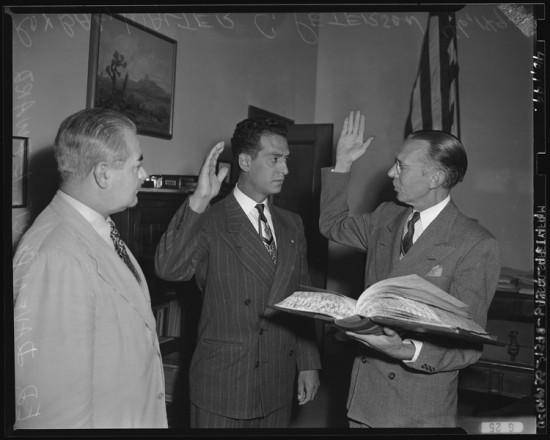
In 1949, Roybal was elected to the LA city council. There were some road bumps.

In 1993, Roybal told The Times that at his first City Council meeting [in 1949], he was introduced as “our new Mexican councilman who also speaks Mexican.”

“My mission was immediately obvious,” he said later. “I’m not Mexican. I am a Mexican American. And I don’t speak a word of Mexican. I speak Spanish.”

It became his role, he said, to educate his fellow public officials about Latinos and to pay special attention to what he felt were the long-neglected needs of his largely Latino constituencies. [Source: LA Times obituary, 2005]

In 1962, Roybal moved on from local politics to the national DC and became the first Latino from California to serve in Congress since 1879 (source). He was later appointed to the Appropriations Committee and became an “influential advocate for federal funding for health, education, community health programs and bilingual education.” [Source]

Some highlights from his long career provided by the USC Edward R. Roybal Institute on Aging:

  • Author of the 1968 legislation that established the National Bilingual Education Act to assist schools in meeting the educational needs of children who come from non-English-speaking homes.
  • Played an important role in the passage of legislation outlawing age discrimination and fought for benefits and opportunities for those with disabilities.
  • Responsible for funding America’s first AIDS research and treatment programs
  • Championed the first federal funding for Alzheimer’s Disease and was instrumental in renewing legislation to provide medical service to people with the disease
  • Led the campaign to restore funding for programs for the elderly, including a senior citizens’ public housing program and a community-based alternative to nursing homes
  • Successfully maintained the Meals on Wheels program and protected veterans’ preferences in hiring in 1982
  • Consumer rights defender
  • Co-founder of the House Select Committee on Aging, serving as chairman from 1983-1993
  • One of the first legislators to introduce legislation to establish a national health plan for the United States
  • Founder of the Congressional Hispanic Caucus, which he served as both president and treasurer
  • Founder of the National Association of Latino Elected and Appointed Officials (NALEO)

I noted Congressman Roybal’s passing in 2005 and wrote: “It’s amazing to think that many of the issues he worked on as a Councilman in the 1950s and then as a Congressman, such as police brutality and immigration, are still problematic. For anyone from LA who has studied the history of Chicana/o politicians, there is no way to avoid the impact of Ed Roybal on the growing political power of Latinos.”

Photo of Edward Roybal being sworn in to the LA City Council in 1949 from the Los Angeles Times photographic archive, UCLA Library. Copyright Regents of the University of California, UCLA Library.

Standard